
CagriSema
CagriSema is an investigational combination therapy being studied for the treatment of obesity and metabolic disorders, including type 2 diabetes. It combines two biologically active compounds that influence appetite regulation and energy metabolism.
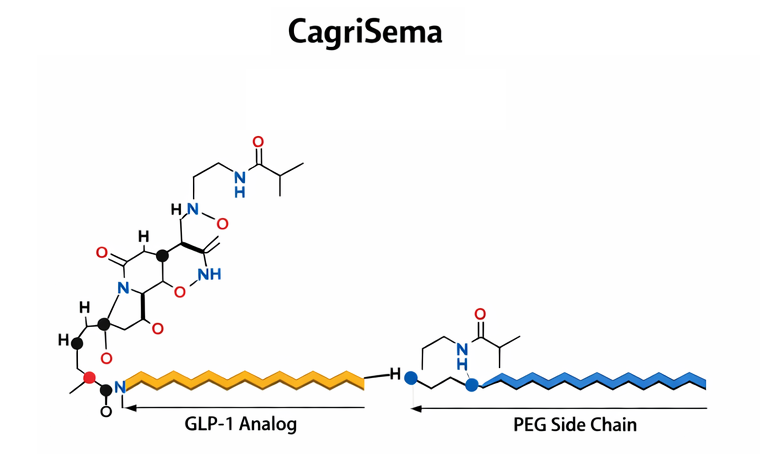
CagriSema consists of Semaglutide and Cagrilintide. The therapy is being developed by Novo Nordisk.
By combining these two mechanisms, CagriSema aims to influence multiple hormonal pathways involved in appetite, satiety, and metabolic regulation.
Because of its multi-hormonal approach, the therapy has attracted significant interest in clinical research related to weight management and metabolic disease. CagriSema is currently considered an investigational therapy and has not yet received full regulatory approval.
How CagriSema works
CagriSema combines two hormones that act on different biological pathways involved in appetite regulation and metabolic control.
Semaglutide acts as a GLP-1 receptor agonist, which may:
increase satiety signals in the brain
slow gastric emptying
improve glucose regulation
Cagrilintide acts as an amylin receptor agonist, which may:
enhance satiety and appetite control
reduce food intake
influence signaling pathways involved in energy balance
Together, these mechanisms may produce complementary effects on appetite suppression and metabolic regulation, which is why combination therapies such as CagriSema are being investigated for long-term weight management.
Clinical trials and evidence
CagriSema is currently being evaluated in clinical trials involving people with obesity and type 2 diabetes. Research has examined:
weight reduction in individuals with obesity or overweight
improvements in glycemic control
changes in metabolic markers associated with energy balance and appetite regulation
Early clinical trials have reported substantial weight loss among participants receiving the combination therapy compared with placebo or individual components alone.
These findings have supported further development of CagriSema in large phase III clinical trials designed to evaluate long-term safety and effectiveness.
However, as with other investigational therapies, additional research is required before regulatory approval can be considered.
Possible side effects of CagriSema:
Because CagriSema influences gastrointestinal and metabolic pathways, the most commonly reported side effects are gastrointestinal symptoms, similar to those observed with GLP-1–based therapies. Reported side effects may include:
nausea
vomiting
diarrhea
decreased appetite
abdominal discomfort
These effects are often dose-dependent and may occur more frequently during the initial stages of treatment.
The complete safety profile of CagriSema continues to be evaluated in ongoing clinical trials.
References:
– Efficacy and safety of co‑administered once‑weekly cagrilintide 2.4 mg with once‑weekly semaglutide 2.4 mg in type 2 diabetes, Frias et al., 2023 – The Lancet, https://www.thelancet.com/journals/lancet/article/PIIS0140-6736(23)01163-7/abstract
– Coadministered Cagrilintide and Semaglutide in Adults with Overweight or Obesity (REDEFINE 1), Garvey et al., 2025 – New England Journal of Medicine, https://mediacenteratypon.nejmgroup-production.org/NEJMoa2502081.pdf
– Cagrilintide–Semaglutide in Adults with Overweight or Obesity and Type 2 Diabetes, Davies et al., 2025 – NEJM, https://www.nejm.org/doi/suppl/10.1056/NEJMoa2502082/suppl_file/nejmoa2502082_protocol.pdf
CagriSema is an investigational combination therapy currently undergoing clinical trials and has not yet been widely approved as a prescription medication by major regulatory authorities. Scientific research involving such compounds should be conducted with appropriate safety precautions and in accordance with applicable laws and regulations in the relevant country.
The purpose of this website is to provide clear, evidence-based information about biologically active compounds often discussed in research, metabolic health, and biohacking communities. The information presented here is educational and should not be considered medical advice.
Related peptides
Peptides from the same functional group:Dulaglutide, Exenatide, Liraglutide, Mazdutide, Retatrutide, Semaglutide